책 이름 받기
#define _CRT_SECURE_NO_WARNINGS
#include <stdio.h>
#include <string.h>

struct book { // 사용자 정의 자료형
	char title[80]; // 상수
	char* author; // 포인터 변
	int page;
	int price;
};

void set_book(struct book* b, const char* t, const char* a, int p, int pr) {
	strcpy(b->title, t);
	b->author = a;
	b->page = p;
	b->price = pr;
}

int main() {
	//struct book mybook = { "C 프로그래밍", "데니스", 180, 18000 };
	struct book mybook;

	set_book(&mybook, "C 프로그래밍", "데니스", 180, 18000);
	//strcpy(mybook.title, "C 프로그래밍");
	//mybook.author = "데니스"; // 포인터 변수면 주소에 주소를 대입하는 것이기 때문에 가능
	//mybook.page = 180;
	//mybook.price = 18000;

	printf("도서명 : %s\\n", mybook.title);
	printf("저자 : %s\\n", mybook.author);
	printf("페이지수 : %d\\n", mybook.page);
	printf("가격 : %d\\n", mybook.price);

	return 0;
}
크래커 정보 설정하기
#define _CRT_SECURE_NO_WARNINGS
#include <stdio.h>

struct cracker {
	int price;
	int kcal;
};

int main() {
	struct cracker c;

	printf("바사삭 가격과 열량을 입력하세요: ");
	scanf("%d %d", &c.price, &c.kcal);

	printf("바사삭 가격: %d원\\n", c.price);
	printf("바사삭 열량: %dkcal", c.kcal);

	return 0;
}
명령행 인수 코드
argc: 인수의 개수
argv: 인수 목록. 각 인수를 문자열로 담고 있는 포인터 배열이다.
wsl 에서 ./파일명 hello world 123 이런식으로 하면
	#include <stdio.h>
	int main(int argc, char** argv) {
		for(int i=0; i<argc; i++) {
			printf("%s\\n", argv[i]);
		}
		return 0;
	}
구조체로 국어, 영어, 수학 성적 표출하기
#include <stdio.h>

struct score {
    int kor;
    int eng;
    int math;
};

int main()
{
    struct score yuni = {90, 80, 70};
    struct score* ps = &yuni;

    printf("국어 : %d\\n", (*ps).kor);
    printf("영어 : %d\\n", ps->eng); // -> : 애로우 연산자
    printf("수학 : %d\\n", ps->math);

    return 0;
}
구조체 배열을 초기화하고 출력하기
#include <stdio.h>

struct address { // 구조체도 배열이 가능하다
    char name[20];
    int age;
    char tel[20];
    char addr[80];
};

int main() {
    struct address list[5] = {
        {"홍길동", 21, "1111-1111", "울릉도 독도"},
        {"이순신", 35, "2222-2222", "서울 건천동"},
        {"장보고", 19, "3333-3333", "완도 청해진"},
        {"유관순", 19, "4444-4444", "충남 천안"},
        {"안중근", 21, "5555-5555", "황해도 해주"},
    };

    for (int i=0; i<5; i++) {
        printf("%10s%5d%15s%20s\\n", list[i].name, list[i].age, list[i].tel, list[i].addr);
    }

    return 0;
}
연결리스트
#include <stdio.h>

// 자기 참조 구초제
struct list {
    int num;
    struct list* next; // 자기 참조 멤버
};

int main() {
    // linked list
    // struct list a = {10, NULL}, b = {20, NULL}, c = {30, NULL};
    struct list a = {10, NULL};
    struct list b = {20, NULL};
    struct list c = {30, NULL};

    // struct list* head, *current;
    struct list* head;
    struct list* current;

    head = &a;
    a.next = &b;
    b.next = &c;

    printf("head->num : %d\\n", head->num);
    printf("head->next->num : %d\\n", head->next->num);

    printf("list all : ");
    current = head;
    while (current != NULL) {
        printf("%d  ", current->num);
        current = current->next; // current의 다음을 따라가기
        // current++;
    }

    return 0;
}
공용체 (메모리 절약)
모든 멤버가 같은 메모리 공간을 가진다 (구조체는 모든 멤버가 개별적인 공간을 가짐)
크기는 가장 큰 멤버의 크기이고 (구조체는 모든 멤버 크기의 합)
한번에 오직 하나의 멤버만 유효함
#include <stdio.h>

union student {
    int num; // 4바이트 정수
    double grade; // 8바이트 정수
};

int main() {
    union student s1 = {315};
    printf("학번: %d\\n", s1.num);

    s1.grade = 4.4;
    printf("학점: %.1lf\\n", s1.grade);
    printf("학번: %d\\n", s1.num);

    return 0;
}
열거형
성능적으로 배열보다 약간 빠름
enum season {SPRING, SUMMER, FALL, WINTER} → 1, 2, 3, 4
enum season {SPRING = 5, SUMMER, FALL=10, WINTER} → 5,6,10,11
#include <stdio.h>
#include <string.h>

enum season {SPRING, SUMMER=5, FALL=10, WINTER};

int main() {
    char input_text[10];
    enum season ss;
    char* pc = NULL;

    printf("계절을 입력하세요(SPRING, SUMMER, FALL, WINTER): ");
    scanf("%s", &input_text); // & 연산자를 사용하여 변수의 주소를 전달
    // ss = SPRING;

    if (strcmp(input_text, "SPRING") == 0) {
        ss = SPRING;
    } else if (strcmp(input_text, "SUMMER") == 0) {
        ss = SUMMER;
    } else if (strcmp(input_text, "FALL") == 0) {
        ss = FALL;
    } else {
        ss = WINTER;
    }

    switch(ss) {
        case SPRING:
            pc = "inline";
            break;
        case SUMMER:
            pc = "swimming";
            break;
        case FALL:
            pc = "trip";
            break;
        case WINTER:
            pc = "skiing";
            break;
    }
    printf("나의 레저 활동 => %s\\n", pc);

    return 0;
}
typedef를 사용한 형 재정의
typedef struct student Student;
#include <stdio.h>

struct student {
    int num;
    double grade;
};

typedef struct student Student; // 새로운 자료형 제공

void print_data(Student *ps);

int main() {
    Student s1 = {315, 4.2};
    printf("학번을 입력해주세요: ");
    scanf("%d", &s1.num);

    printf("학점을 입력해주세요: ");
    scanf("%lf", &s1.grade);

    print_data(&s1);
    return 0;
}

void print_data(Student *ps) {
    printf("학번: %d\\n", ps->num);
    printf("학점: %.1lf\\n", ps->grade);
}
완전수 구하기
#include <stdio.h>

int main() {

    int num, sum = 0;

    printf("숫자를 입력해주세요: ");
    scanf("%d", &num);

    for (int i=1; i<= (num/2); i++) {
        if (num % i == 0) {
            sum += i;
        }
    }

    if (sum == num) {
        printf("완전수입니다\\n");
    } else {
        printf("완전수가 아닙니다\\n");
    }

    return 0;
}
소수 구하기
#include <stdio.h>

int main() {

    int i=1;

    for (int i=2; i<=100; i++) {
        int count = 1;
        for (int j=2; j<=(i/2); j++) {
            if (i % j == 0) {
                count++;
                break;
            }
        }

        if (count == 1) {
            printf("%d ", i);
        }
    }

    return 0;
}
wsl 실습
wsl -- list --online # 페도라가 레드햇 중에는 가장 빨리 업데이트됨
wsl --install -d Ubuntu
wsl --list --verbose
wsl -l -v
wsl -v -l # 버전이 나옴
clear

wsl -l -v
wsl -d Ubuntu
cd ~/ # 집으로 가기
pwd
gcc
g++
make
sudo apt update
sudo apt install # 리눅스 우분투에서 어플 다운받는 명령 -> 설치하기 위해서는 저장소를 알아야함
sudo apt install build-essential -y
ls
cd work # mkdir work 로 만든 것
ls -l
man man
man ls
ls -l -a
cd basic
nano add.c
	#include <stdio.h>
	int main() {
		int a, b;
		printf("두 정수를 입력하세요: ");
		scanf("%d %d", &a, &b);
		printf("두 정수의 합은: %d\\n", a+b);
		return 0;
	}
gcc -o add.exe add.c # 실행파일 생성
./add.exe # 실행

코딩
ls -l
rm a.out
rm *.o
rm add.exe app01 hello
mkdir AAA
rm AAA
rm -rf AAA # recursive false 또는 rmdir
vi Ex16-6.c
	//명령행 인수 코드
	#include <stdio.h>
	int main(int argc, char** argv) {
		for(int i=0; i<argc; i++) {
			printf("%s\\n", argv[i]);
		}
		return 0;
	}
clear
ls
gcc -o 16-6 Ex16-6.c
ls -l # r, x 권한이 있음 / 만든사람 / 계정그룹 / byte / 만들어진 날짜 / 파일명
./16-6 first second # ./16 까지 치고 탭
exit
exit
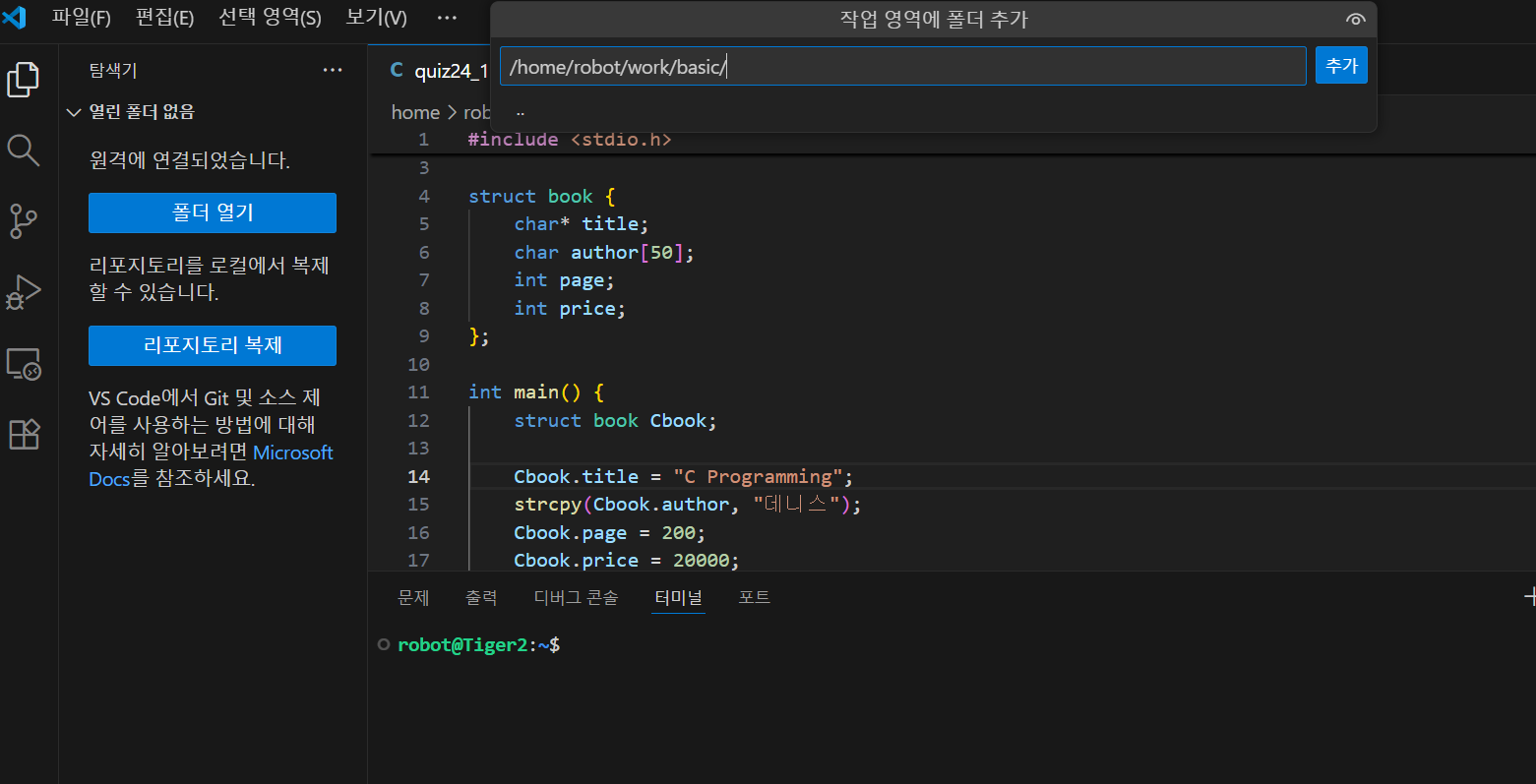
작업영역에 폴더 추가
'c' 카테고리의 다른 글
| c 언어 문제 (0) | 2025.11.14 |
|---|---|
| 파일처리 (0) | 2025.11.13 |
| 배열, 포인터와 구조 (0) | 2025.11.11 |
| 이중포인터 N차원 배열 (1) | 2025.11.10 |
| 문자열 (0) | 2025.11.07 |